

As an Italian Wine Ambassador I was once again invited by the Alto Adige / Südtirol Consorzio to contribute to the October promotion month in Belgium. Last year I kept the scope broad, this time I chose focus. A grape with a nearly indestructible reputation in Burgundy that also delivers wines of class in northern Italy, Pinot Nero. Or, if you prefer, Pinot Noir. What started as an idea became a deep dive into Alto Adige / Südtirol, with attention to location, altitude and soils, and to the way producers shape the grape in the cellar and the vineyard. I measured it against two benchmarks, the famous wines of Burgundy and the style of neighbouring Trentino. The result is a journey through an Alpine landscape where cool nights, sun-drenched slopes and limestone-rich soils meet, and where Pinot Nero shows precision, fine red fruit and a taut arc of tension. A story about how terroir in Alto Adige / Südtirol speaks today as convincingly as in its illustrious French cradle.
Alto Adige / Südtirol: Viticulture between the Alps and the Mediterranean
Say Alto Adige / Südtirol and you say contrast. This small wine region at the far north of Italy, part of Austria until 1919, is wedged between the Alps and the Dolomites and borders Austria and Switzerland. Bilingualism, German and Italian, reflects not only history but also the interplay of cultures in this unique area. The name refers to the Adige River, Etsch in German, which winds from north to south through the valleys and shapes the wine landscape.
With barely 5,800 hectares of vineyards, Alto Adige / Südtirol is one of Italy’s smallest wine regions, accounting for less than one percent of the national area. Yet the diversity is remarkably large. 4.800 winegrowers work an average of only 1.2 hectares, often on steep slopes between 200 and 1,000 meters altitude. Here wine is literally made on the mountainsides.
Although the region was traditionally known for red wines from Schiava, Vernatsch, Alto Adige / Südtirol is today above all a white wine region. Sixty-five percent of production is white varieties such as Pinot Bianco, Sauvignon Blanc and Gewürztraminer. The remaining thirty-five percent is red, dominated by Pinot Nero and Lagrein, which achieve a strikingly precise and refined style here.
Quality is central. Ninety-eight percent of all wines carry DOC status, unique in Italy. With production around forty million bottles per year, one third exported, Alto Adige / Südtirol proves that greatness lies not in size but in character.
Geology and Soils: The Backbone of Alto Adige / Südtirol
To understand the complex structure of Alto Adige / Südtirol, you must start with the soil. The region is a geological wonder, shaped by the collision of the European and African tectonic plates. That ancient fault line, the so-called Periadriatic Seam, runs right through the area and creates exceptional diversity of rock.
Within this small wine region there are more than one hundred and fifty different soil types, ranging from volcanic porphyry and weathered quartz and mica to limestone and marl. Even within a single vineyard the composition can change perceptibly. This mosaic explains the wide variation in style, tension and texture of the wines.
In the south, volcanic porphyry soils dominate, especially around Bolzano and the Bassa Atesina. They give power, color and depth. In the valleys and higher up we find light, weathered soils of quartz and mica that contribute finesse and aromatic precision. Farther north toward the Dolomites, limestone and marl take over, giving the wines marked minerality and energy.
A unique element is the presence of dolomitic limestone, formed from ancient marine deposits. These weathered rock soils are rich in minerals and offer an exceptional terroir for characterful wines. The vine roots must search deep, which results in wines with complexity, expression and a recognizable saline touch.
The combination of geological complexity with steep slopes and shifting elevations makes Alto Adige / Südtirol one of the most varied wine regions in the world.
Climate: Where Alpine Air Meets Mediterranean Sun
The climate of Alto Adige / Südtirol is one of the keys to its wine character. The region sits at the crossroads of two worlds, the cool, mountainous Alps to the north and warmer Mediterranean influences that enter via the Po Valley and Lake Garda. The interplay delivers a near paradoxical harmony of freshness and ripeness.
On average, Alto Adige / Südtirol enjoys more than three hundred days of sunshine per year, exceptional for a mountain region. The Alps form a natural barrier against cold northerly winds, while from the south warm air flows up into the valleys. Between these two air masses countless microclimates arise, each with its own balance of temperature, wind and humidity.
The Dolomites play a key role. They divide the landscape into narrow valleys with different orientations, which creates a large variety of mesoclimates. A vineyard at 400 meters in Caldaro can have a completely different microclimate than a plot at 900 meters in the Val Venosta.
The day to night temperature swings are among the largest in Europe. Slopes warm strongly during the day, while night time cooling lets the grapes breathe and preserves aromas. This natural temperature pendulum is essential for freshness, color and aromatic intensity, especially for Pinot Nero.
Pinot Nero in Alto Adige / Südtirol: Precision at Altitude
Pinot Nero, internationally better known as Pinot Noir, is one of the oldest cultivated grape varieties in our regions. The variety arose more than two thousand years ago from a cross between wild Vitis vinifera sylvestris and an early cultivated vine. In Burgundy it was already described in the early Middle Ages and from there it spread across the Alps to northern Italy. The long history also explains the wealth of names, Pinot Nero, Blauburgunder, Spätburgunder, all pointing to the same noble grape.
The first plantings in Alto Adige / Südtirol date to around 1835, with a clear intensification around 1860 in Merano, Egna and Appiano. The region proved ideal, cool enough to preserve freshness, yet with enough sun to ripen the fruit.
Pinot Nero is not an easy grape. It demands care and precision in vineyard and cellar. In Alto Adige / Südtirol it is mainly planted in three areas, Oltradige with Appiano and Caldaro, Bassa Atesina around Montagna, Egna and Salorno, and Merano with the Val Venosta. The best results come from west facing slopes at 400 to 500 meters, where the grape benefits from sun and air circulation and is protected from extreme heat.
Within the new UGA classification, Unità Geografiche Aggiuntive, officially approved on 18 October 2024, Mazzon near Egna and Glen near Montagna are regarded as top references for Pinot Nero. Both sites combine limestone rich soils with ideal gradient and altitude, which results in wines with depth, finesse and a recognizable tension.
Worldwide Pinot Noir covers about 118,000 hectares, with France, Burgundy and Champagne, as the leading producer. Italy has around 5,000 hectares, with Lombardy, Oltrepò Pavese, the largest by area, but Alto Adige / Südtirol is the epicenter of quality with about 600 hectares. Plantings have grown steadily since the nineteen sixties, driven by demand for cool climate wines.

Pinot Noir: One Grape, Three Faces
Burgundy, Alto Adige / Südtirol and Trentino Compared
Pinot Noir is a grape that rarely simply adapts. It is fascinating to see how three regions, Burgundy, Alto Adige / Südtirol and Trentino, each developed its own interpretation of the same grape, with clearly recognizable signatures.
Burgundy: The Benchmark
This is where the story began. Vineyards sit at 200 to 400 meters, in a cool continental climate distinguished by subtle microclimates between the Côte de Nuits and the Côte de Beaune. Limestone and marl soils, Kimmeridgian and Bathonian, are decisive, as is the fine-grained cru structure that has existed for centuries.
Pinot Noir shows delicate, earthy and layered character. Aromas of red cherry, raspberry and forest floor, sometimes leather or mushroom with age. The color is often light and evolves quickly toward garnet. The structure is fine and linear, carried by lively acidity. Burgundy excels in tension between fruit and complexity. Young wines are often restrained, but they mature into a symphony of truffle, sous-bois and dried flowers.
Alto Adige / Südtirol: Precision
Pinot Nero from Alto Adige / Südtirol plays a different register. The Alpine climate with strong day night shifts and a longer growing cycle creates an unusual interplay of freshness and ripeness. Vineyards lie between 400 and 800 meters, often on west facing slopes that profit from sun and cool mountain breezes.
The soils are geologically complex. Volcanic porphyry, mica, quartz, limestone and sandstone alternate from valley to valley. Clonal selection is considered. Burgundy clones 115 and 777 bring fruit and structure, while Swiss Mariafeld, and German, Freiburg, clones give looser bunches and healthier harvests.
The result is a wine with more color intensity than Burgundy, bright aromas of raspberry, blackberry, cherry and violets, and a hint of white pepper or clove. On the palate it shows fine yet slightly firmer tannin, great precision and palpable mineral tension. Pinot Nero from Alto Adige / Südtirol is usually fruit driven and combines mountain freshness with energy. It can age well, though it aims more for clarity than for tertiary complexity.
Trentino: Riper in Tone
Trentino sits right next to Alto Adige / Südtirol, yet the climate differs. Alpine and sub Mediterranean influences meet here, with slightly higher temperatures and softer day night contrasts. Vineyards are between 300 and 700 meters, often on steep terraces in the Cembra Valley or the slopes of the Vallagarina.
Soils are very diverse, limestone and alluvial material to volcanic porphyry, which yields different styles. Producers mainly use Burgundy clones, 115, 777, 943, for structure and ripening, supplemented with Swiss Mariafeld clones in cooler plots.
In the glass Trentino Pinot Nero is round, ripe and more accessible than its neighbor to the north. Aromas lean toward red cherry, strawberry and plum, sometimes with Mediterranean herbs or a balsamic accent. Acidity is softer, tannin rounder, body a touch fuller. The style combines mountain freshness with a hint of warmth, less strict, yet seductive and generous.
The Tasting: Pinot Nero in All Its Faces
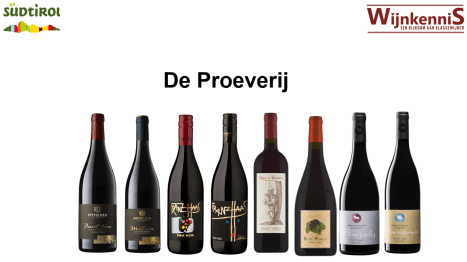
To make the story of Pinot Nero tangible, we organised a tasting that let the diversity of the grape in the mountains speak. The setup was simple and deliberate, four wineries, two wines each, to show how terroir, altitude and winemaking set the tone.
We chose not to lose ourselves in the scale of cooperatives and focused on small, family run estates.
We also wanted contrast. So we added a neighbor from Trentino alongside Alto Adige / Südtirol wines. The tasting could then give a truthful picture of how this grape behaves in two adjacent yet clearly different terroirs.
At each estate we started with the classic Pinot Nero, then moved to the more ambitious cuvée, the wine where selection, maturation and altitude come together. That double approach made it possible to taste evolution and ambition within one house and to discover how subtly style shifts in Alto Adige / Südtirol.
Pojer e Sandri, Pinot Nero 2024, IGT Vigneti delle Dolomiti
The vineyards of Pojer e Sandri lie in the heart of the Cembra Valley, between the villages of Faedo and Palai, at elevations of 300 to 700 metres. The subsoil is a mix of volcanic rock with inclusions of sandstone, slate and marl. Part of the wine ages briefly in wood to add structure and depth, the rest remains in stainless steel.
In the glass the wine is light ruby and translucent, with an immediately charming nose. Fresh aromas of strawberry and raspberry stand out, supported by a subtle floral touch. The palate follows suit, light footed, with a clear acid line that gives tension and length. The fruit is playful and juicy with a fine, lively texture. This Pinot Nero celebrates pure red fruit, with a refreshing acidity that drives the flavour from start to finish.
Price: €20.20, available via Wijnkennis
Franz Haas, Pinot Nero 2022, DOC Südtirol / Alto Adige
The Pinot Nero from Franz Haas comes from the steep slopes of Montagna, a historic reference area for this grape in the Bassa Atesina. Vineyards are scattered between 350 and 900 metres on loam and limestone. The altitude differences bring tension to the wine. Lower plots deliver ripe fruit, higher plots add freshness and structure. Fermentation takes place in stainless steel tanks, followed by twelve months in barriques.
The result is a Pinot Nero that couples finesse with depth. In the glass it shows a light ruby colour with cherry red highlights. The aroma is expressive and lively, with blueberry, riper cherry and even plum, complemented by violets, lavender, rosehip and wild herbs. Subtle notes of bay, pine needles and orange peel appear. The taste is refined, precise and silky, with fine grained-tannin and energetic acidity. It is juicy, fresh and tightly structured, with a long, lightly spicy finish. Pinot Nero with great freshness and precision, a wine that unites tension and beauty, masterfully executed by Franz Haas.
Price: €28.40, available via Wijnkennis
Gump Hof, Praesulis Pinot Nero 2022, DOC Südtirol / Alto Adige
A visit to Markus Prackwieser, like his wines, is enriching. From his Gump Hof estate, tucked against the steep flanks of the Sciliar massif in the Valle Isarco, he manages some of the highest Pinot Noir vineyards. The plots lie between 500 and 550 metres, with slopes up to 55 percent, on complex soils of volcanic porphyry with limestone moraine deposits. Although Prackwieser likes to describe himself as a white wine specialist, his Praesulis Pinot Noir proves the contrary.
The wine comes from meticulous work in the vineyard with low yields, 45 hectolitres per hectare, and vinification where precision is central. Fermentation in stainless steel tanks preserves pure fruit aromas, followed by twelve months ageing in French barriques that add structure and complexity without overshadowing the fruit.
In the glass the wine shines bright cherry red. The nose opens with red and black berries, cherry, plum and subtle touches of leather and spice. The palate is juicy, fresh and balanced, with fine acidity and a silky structure. Wood use remains discreet and woven in, so the wine keeps balance and purity. The finish is long, spicy and precise, carried by mineral tension. Complex, harmonious and crystal clear, a Pinot Noir that illustrates the craftsmanship of Markus Prackwieser and convincingly brings the finesse and potential of the Valle Isarco into the glass.
Price: €35.00, available via Wijnkennis
Weingut Pfitscher, Fuchsleiten Pinot Nero 2018, DOC Südtirol / Alto Adige
Say Montagna and you say Pinot Nero. The steep, sunlit slopes above the Adige have been the epicenter for this grape in Alto Adige / Südtirol for decades. The vineyards of Pfitscher lie between 350 and 700 metres, where loam and limestone dominate. Fermentation in stainless steel tanks for ten to fourteen days, followed by a few months of ageing in oak to give the wine rounding and depth without weighing it down.
In the glass the wine shines bright ruby. The nose is seductive and complex, a mix of small red fruit, wild strawberries, raspberry, and darker tones of cherry and blackberry, with a subtle floral note and a hint of earth. With some swirling, nuances of mushroom and humus appear, wrapped in a fine smoky accent that elegantly reveals the wood. The taste is silky and harmonious, with lively acidity that keeps the fruit fresh and tannin that is very fine yet present. Juicy, seductive and well balanced.
Price: €23.90, available via Wijnkennis
Franz Haas, Pinot Nero Schweizer 2020, DOC Südtirol / Alto Adige
Pinot Nero Schweizer is one of the most emblematic wines of Franz Haas, a cuvée made only from the best grapes from carefully selected plots in Montagna. After careful cluster selection, fermentation takes place in stainless steel to preserve fruit, followed by twelve months ageing in barriques.
In the glass the wine shines ruby with a subtle gloss. The nose is alluring and intense, with ripe berries and cherries, a hint of pepper, leather and gentle spice. The aromas unfold in layers and give a sense of elegance and depth. The palate is balanced, silky and very refined. Tannin is subtle and polished, structure is seamlessly woven and acidity provides vibrancy and tension. The finish is long, harmonious and subtly spicy. Franz Haas describes this wine as for those who live intense emotions, and that is no exaggeration. Pinot Nero Schweizer combines power and grace, made for those who seek emotion in a glass.
Price: €42.90, available via Wijnkennis
Pojer e Sandri, Pinot Nero Rodel Pianezzi 2018, IGT Vigneti delle Dolomiti
Pinot Nero Rodel Pianezzi is a wine with a pronounced mountain character, from vines over 35 years old in the Rodel Pianezzi hamlet near Faedo in Trentino. The vineyard lies around 500 metres. The soil is an intriguing mix of volcanic rock, sandstone, slate and marl. Vinification takes place in open wooden vats. After fermentation, the wine ages twelve months in barriques, followed by another year in bottle.
This patience yields a Pinot Nero that is powerful, refined and crystal clear. In the glass the wine shows deep ruby. The nose is open and inviting, with wild strawberry, raspberry, ripe cherry and plum, surrounded by fine notes of tobacco, sage and clove. With some aeration, hints of sweet spice, liquorice and mint unfold, adding extra complexity. The palate is harmonious and equally complex, with perfect balance. The structure is round, supple and nuanced, supported by subtle spice and a saline, mineral tone. The wood aging is discreet and well integrated, so the wine retains its fine balance. The finish is long and refined, with echoes of cinnamon and licorice that slowly fade. A Pinot Nero of class and character, a wine that couples strength to refinement and clearly proves why Faedo is among the most intriguing terroirs of Trentino.
Price: €37.20, available via Wijnkennis
Weingut Pfitscher, Pinot Nero Riserva Matan 2016, DOC Südtirol / Alto Adige, UGA Glen
Matan Riserva comes from the Glen vineyard in Montagna, one of the most valued crus within the UGAs of Alto Adige / Südtirol, officially reconised on 18 October 2024. Vines grow here at 550 to 600 metres on slopes of loam and limestone. Fermentation in stainless steel for fourteen to sixteen days, followed by twelve to fifteen months ageing in a combination of French barriques, 225 liters, and larger oak casks.
In the glass the wine shines bright ruby. The nose is intense and complex, with ripe red fruit, blueberries and black cherries, framed by subtle notes of vanilla and light spice. There is refined tension between ripeness and freshness on the palate. It is powerful and balanced, with perfect harmony between fine acidity and ripe fruit. The structure is impressive, carried by silky tannin that shows fully only in the long finish. Matan Riserva unfolds gradually. A Pinot Nero with depth, suppleness and a serene balance.
Price: €48.50, available via Wijnkennis
Gump Hof, Pinot Nero Riserva Renaissance 2020, DOC Südtirol / Alto Adige
Stand high on the steep slopes of the Sciliar massif near Fiè allo Sciliar and you immediately understand why Markus Prackwieser finds inspiration here. Renaissance Riserva is his masterpiece, a wine that translates the character of this exceptional place with striking precision. The vineyards lie between 500 and 550 metres, with slopes up to 55 percent, cooled constantly by night winds from the Dolomites, while during the day warm air rises from Lake Garda. These unique airflows, combined with limestone rich moraine soils full of quartz and porphyry, yield wines with tension, aromatic finesse and near unmatched refinement.
The grapes ferment in stainless steel, followed by eighteen months ageing in French barriques and another six months in large wooden casks. The long maturation brings structure, depth and an almost velvety texture without the wine losing its mountain fresh energy. In the glass Renaissance is garnet red, lively and bright. The nose enchants, black cherry, wild berries and red fruit compote alongside red flowers, wild herbs, humus and sous-bois. A subtle earthy touch adds depth, a signature of the terroir.
The palate is delicate and intense at once. The wine opens spicy, with notes of pepper and sous bois, then unfolds with a silky structure and refined freshness. The finish is long, complex and layered, with mineral tension that resonates.
Price: €79.70, available via Wijnkennis
Closing Thoughts
The tasting was carefully built, with wines that together sketched a clear picture of what Pinot Nero from northern Italy can do. What lingers most is the diversity within an apparently small area. Within Alto Adige / Südtirol the style of Pinot Nero proved not only grand, it was layered and nuanced. Even within one and the same municipality, Montagna, home to both Weingut Pfitscher and Franz Haas, the difference is almost astonishing. The hand of the winemaker certainly plays a role, but just as decisive is the precise position of the plots. Orientation, altitude and soil composition leave an indelible mark on the final result.
The comparison with Trentino yielded compelling insights. On paper the differences seem subtle, in the glass they were tangible. None of the other wines had such a pronounced acid profile as the opener from Pojer e Sandri. The wine was anything but overripe, rather lively and energetic, with a playful character that charmed immediately. It is a wine that will appeal to lovers of lighter, fresher styles, where acidity carries the wine without sharpness. Rodel Pianezzi, by contrast, fit perfectly into the Trentino Pinot Nero story.
Montagna confirmed its status as one of the most impressive terroirs of Alto Adige, a place where Pinot Nero finds its most pure form, wines with energy, length and character. Then there was the surprise of the Valle Isarco, often underexposed in the literature, yet a revelation in the glass. The wines of Gump Hof proved that farther north, in cooler valleys, Pinot Nero can reach a stunning expression, mountain air in liquid form.
This tasting showed that Pinot Nero in Alto Adige / Südtirol cannot be captured in a single style or typology. It is a grape that here, more than anywhere else in Italy, translates the landscape into finesse, tension and emotion. That is precisely where its greatness lies.
Filed under: Vini Italiani | Tagged: Alto Adige, altoadigewines, franz haas, gump hof, Italian wine ambassador, Pfitscher, pinot nero, Pinot Noir, pojer e sandri, Sud Tirol, wijn, wijnkennis | Leave a comment »



 Bottle Case